


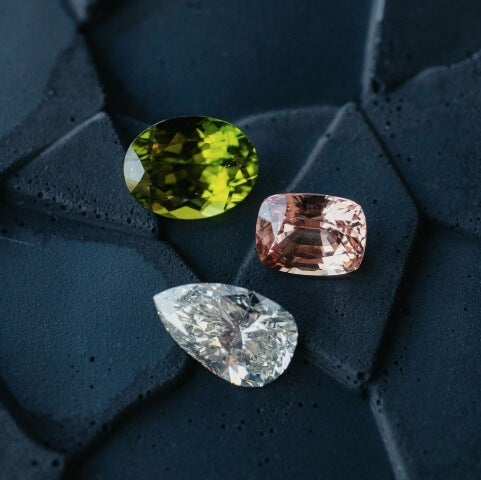
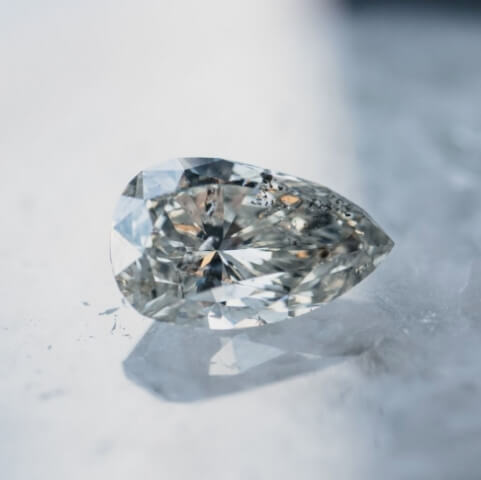

Gemstones and diamonds have fascinated humans for our entire existence since first encountered. Sometimes I find myself trying to describe to someone what it is about gemstones that creates such feelings of wonder for myself and other fellow gem enthusiasts. Humans place artificial values on things, but true rarity cannot be cheated. Even if the mineral itself is not particularly valuable, looking at a crystal specimen and knowing that it was formed in the Earth by coincidental colliding elements is fascinating to me. When was the last time you were walking casually through a park and saw a clear, brilliantly colored crystal among the gravel? Probably never, and that's what makes gemstones so fascinating. I often also imagine the first peoples coming upon these stones and how unbelievably different from everything else around them they were. Back when I was in undergrad, I struggled to envision a practical intersection between my greatest passions: art, zoology, and earth sciences. Jewelry feels like the perfect intersection, and that scientifically trained side of my brain gets very excited at the sight of unique material!
While a sparkling colored stone, crystal, or natural diamond is obviously captivatingly beautiful, there is a class of stones that have held human fascination for as long as we have known them. Gems that exhibit optical effects under different lights, taking the form of cat-eyes, dramatic color changes, blue sheens, and pointed stars, have a very fitting name. Today I want to talk a little bit about phenomenal gemstones.
When I say phenomenal in this context, it's not just my enthusiasm for all rocks, gems, and minerals. Phenomenal minerals are a small subgroup of stones and gemstones defined by their optical effects, which we call phenomena. There are a good number of different types of gems that exhibit visual phenomena, and different categories of said phenomena. If you're looking for a gemstone that can make you feel like you're gazing into a crystal ball, you’re looking at a magic ring that changes colors at different times of day, or anything else that really mesmerizes, here are the phenomena you can expect and what gems to find them in.
Iridescence
Probably the most widely recognized of all mineral phenomena, iridescence refers to the colors visible on the surface of a gem or mineral when light passes through super-thin layers of inclusions or films with a refractive index different than the base mineral. A refractive index refers to a ratio of the velocity of light in a vacuum to its velocity in a specific medium. The colors in iridescence can often be described as reminiscent of an ‘oil slick,’ with secondary-hued rainbows of color. The protective inner coating that is produced by mollusks like oysters and abalone creates beautiful iridescence in shells called nacre — sometimes known as mother of pearl. Pyrite, fire agate, aforementioned mollusk shells, spectralite, and labradorite are iridescent, but labradorite’s unique style of iridescence is known as labradorescence.

Chatoyancy
Also called chatoyance or cat’s eye, chatoyancy is an optical effect in cut gemstones caused by light reflecting off fibrous structures, inclusions, and cavities within the stone, such as rutile. Most people first see it in the form of the very common gemstone tiger’s eye. It creates less of a cat-eye effect and more of a unique layered iridescence. True cat-eye gems are usually cabochon cuts shaped round or oval and will have one central defined reflective line that kind of moves with you as you move it, following you like an eye. These gemstones are great for use in sculptural animal pieces for their resemblance to certain animal eyes. They also make for very dramatic statement rings.
Chatoyancy can be found in labradorite, selenite, chrysoberyl, tourmaline, quartz, and some other gems.
 Image courtesy of the Gemological Institute of America (GIA). Source:
“Cat’s-Eye Brazilian Paraíba Tourmaline,” GIA
.
Image courtesy of the Gemological Institute of America (GIA). Source:
“Cat’s-Eye Brazilian Paraíba Tourmaline,” GIA
.
Asterism
Very similar to chatoyancy, asterism’s name refers to stars due to the four- or six-rayed pattern of light reflected off them. The star itself is formed by inclusions of rutile within the gem that reflect depending on the light. The most commonly known examples of asterism would be star ruby or sapphire, but it's also known to be found in tiger’s eye, indicolite, and a few rare others.

Adularescence
Adularescence very commonly occurs in the feldspar family, which is responsible for moonstone and sunstone. A sort of hazy, bluish light in a gem is created by the diffraction and reflection of natural light through its different crystal structure layers. Most folks are introduced to adularescence via fluorescence from moonstones, which are one of the birthstones for June. Interestingly enough, when you look up into the sky on a mostly clear and sunny day with a few clouds, you can sometimes see the same effect! The different layers of water vapor within the clouds cause the light that passes through to be deflected by the time the light reaches our eyes. This is how moonstones and sunstones got their names. To me, moonstones look like a little drop of water under full moonlight, and sunstones look like a little sparkling drop of sunlight. How appropriate!
Adularescence is also sometimes referred to as ‘schiller.’ It is a similar concept, but a different visual representation. Rather than milky or iridescent swaths of color, Oregon sunstone tends to represent schiller more like reflective bits or strands of metal. It is caused by light reflecting and refracting against almost parallel inclusions of another material, often the highly reflective rutile. Oregon's state gemstone, the Oregon sunstone, is a fascinating variety of feldspar that often showcases schiller in fantastical effects. In the case of that gem, the schiller comes from little platelets of copper inclusions. Rainbow lattice sunstone from Australia takes that effect and multiplies it to make an incredible rainbow latticework. Aventurine achieves this effect with microscopic hematite crystals.
It can be found in moonstone, sunstone, and aventurine.

Color Change
When you can't make up your mind on what color or colors you want, color-change gems give you the best of both worlds! Color change occurs in gemstones when different kinds of light reflect and refract from the stone, causing it to appear different colors in different lighting. The most well-known color-change gem would have to be Alexandrite. A type of chrysoberyl, Alexandrite with strong color change is an incredibly rare mineral. It's believed that Russian Alexandrite, considered the best the world has seen and the world’s first discovered color-change stone, has been completely mined out. Seeking those stones in particular is quite the endeavor. Alexandrite has also been found in South America and India. It exhibits the most dramatic color change of any stone. Very distinct color change is incredibly rare and commands a high price point. Thankfully, a synthetic form of Alexandrite is widely available to the public at considerably lower price points. It's not exactly the same look as a natural stone, but it is pretty close and offers a fun color change.
Other stones that exhibit color change are sapphire, garnet, fluorite, spinel, andesine, and zultinite.

Opalescence
As the name implies, opalescence occurs in the formation of opal, which gives it the magical look that we love and crave. Opal is formed by microscopic beads of silica bonding with hydrogen molecules. Each “bead” is a perfect sphere, so depending on the angle you're looking at it from will affect the play of color and how it reaches your eye. A small piece of opal can contain millions of silica spheres. What's amazing about opalescence is how it forms with organic structures. Since opal is just tiny beads of silica bonded with water, it has a tendency to be found in strange places. Silica is the most abundant mineral on Earth, comprising most of the sand that you see at a beach or in the desert. If those beads of silica were to enter a void in the ground left over by a buried organic creature that has broken down, leaving an empty mold, as long as silica and water can make their way in, things can start to opalize. Australia has great examples of this, since they have huge deserts with lots of sand. There have been a good number of discoveries over the years of opalized previously living material.

There's a lot of little subcategories of phenomena in gemstones, but these are the basics. If you are looking for something really unique and natural for your engagement ring, wedding bands, etc., consider color-change stones! I guarantee myself and my fellow designers at Baraka are always excited to work with something truly unique.

 4.9 | 575+ Verified Reviews • Authentic Craftsmanship • Unmatched Service